Material Specification
General Overview
The material selection process shall ensure that the material is compatible with the service fluids to which it is exposed over the full design temperature range so that the mechanical, physical and chemical properties of the GRP satisfy the design requirements throughout the intended lifetime.
Review & Acceptance: KTI shall provide the details of the raw materials and resin systems intended to be used for the project during the technical bid stage for the company Review and acceptance.
Fiberglass pipe is a composite material system produced from glass fiber reinforcements, thermosetting plastic resins, and additives. By selecting the right combination and amount of materials and the specific manufacturing process, KTI can create a product to meet the most demanding requirements.
The Material System
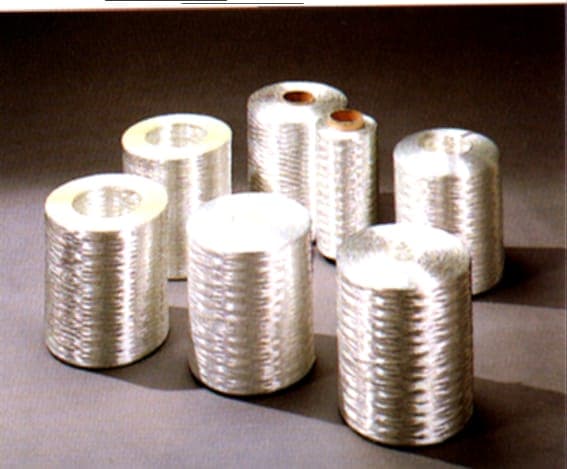
The principal reinforcement material of the component wall shall be glass fibre, e.g. continuous E-Glass and/or woven rovings. Fiberglass composites consist of glass fiber reinforcements, thermosetting resins, and additives, which are designed and processed to meet specific functional performance criteria.
The following is a list of raw material used in describing the material system.
Fiberglass reinforcement
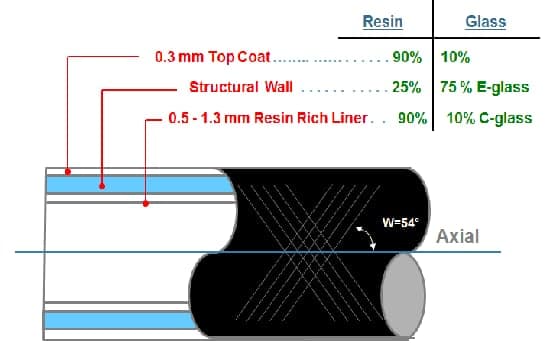
The amount, type, location, and orientation of glass fibers in the pipe that will provide the required mechanical strength.
The glass fibers most commonly used in pipe are referred to as Types E, ECR, and C.
- Glass types ECR and C provide improved acid and chemical resistance.
- Type C glass fibers are generally only used to reinforce chemical-resistant liners.
Resins
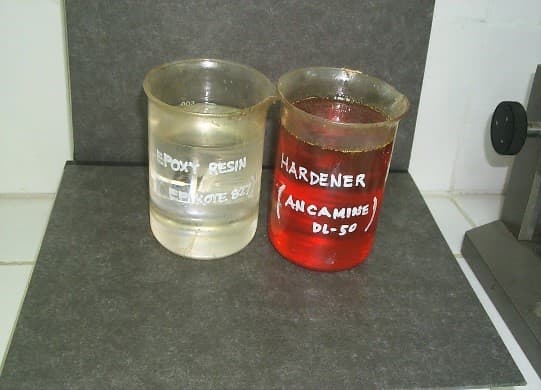
The second major component of fiberglass pipe is the resin system. Manufacturers choose a resin system for chemical, mechanical, and thermal properties and process ability.
Fiberglass pipe, by definition, uses only thermosetting resin systems. Thermosets are polymeric resin systems cured by heat or chemical additives.
Once cured, a thermoset is essentially infusible (cannot be remelted) and insoluble.
The temperature range of different resins is shown in the table below.
Temperature Limitations for GRP
Cured Resin Design Limits
| Type GRP | Design Temperature | Typical Tg value of fully cured resin |
|---|---|---|
| Glass-fibre/epoxy(GRE) | ||
| Aromatic-amine cured(MDA) | 100 °C | 130 °C |
| Cyclo-aliphatic cured(IPD) | 100 °C | 130 °C |
| Aliphatic-amine cured | 85 °C | 115 °C |
| Anhydride cured | 85 °C | 115 °C |
| Glass-fibre/vinyl ester (GRV) | 90 °C | 120 °C |
| Bisphenol A | 100 °C | 140 °C |
| Glass-fibre/polyester(GRP) | ||
| Isophthalic | 60 °C | 90 °C |
Epoxy Resin
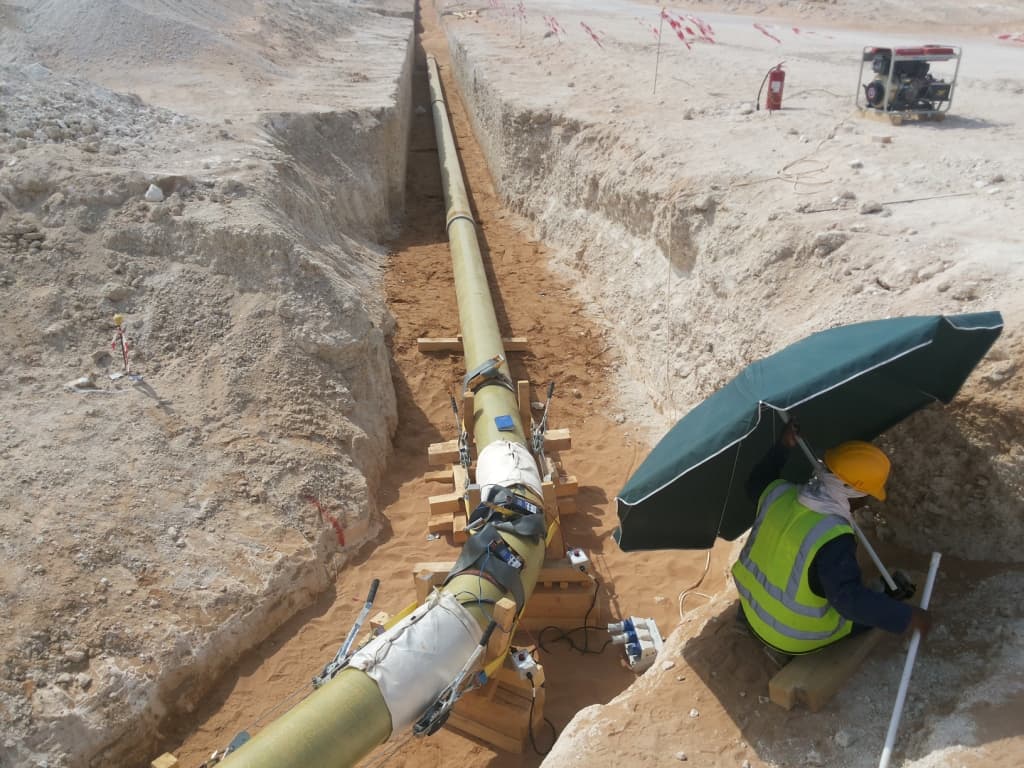
Epoxy resins are used to a wide range of moderately strong acids and alkalis, conveying water, condensates, hydrocarbons and caustics Fiberglass epoxy piping is used in oil fields at pressures up to several thousand per square inch (kilopascals).
Epoxy resins cannot be categorized by resin type as easily as polyesters. The type of curing agent, or hardener, is critical with epoxy resins because the agent influences the composite properties and performance.
Technical Performance
For optimum chemical resistance, these mixtures usually require a heat cure and/or post cure. The cured resin has good chemical resistance, particularly in alkaline environments, and can have good temperature resistance.
Curing Agents
- Cyclo aliphatic amine (IPD)
- Aliphatic amine
- Aromatic amine (MDA)
- Anhydride
* IPD is most commonly used.
Polyester Resin
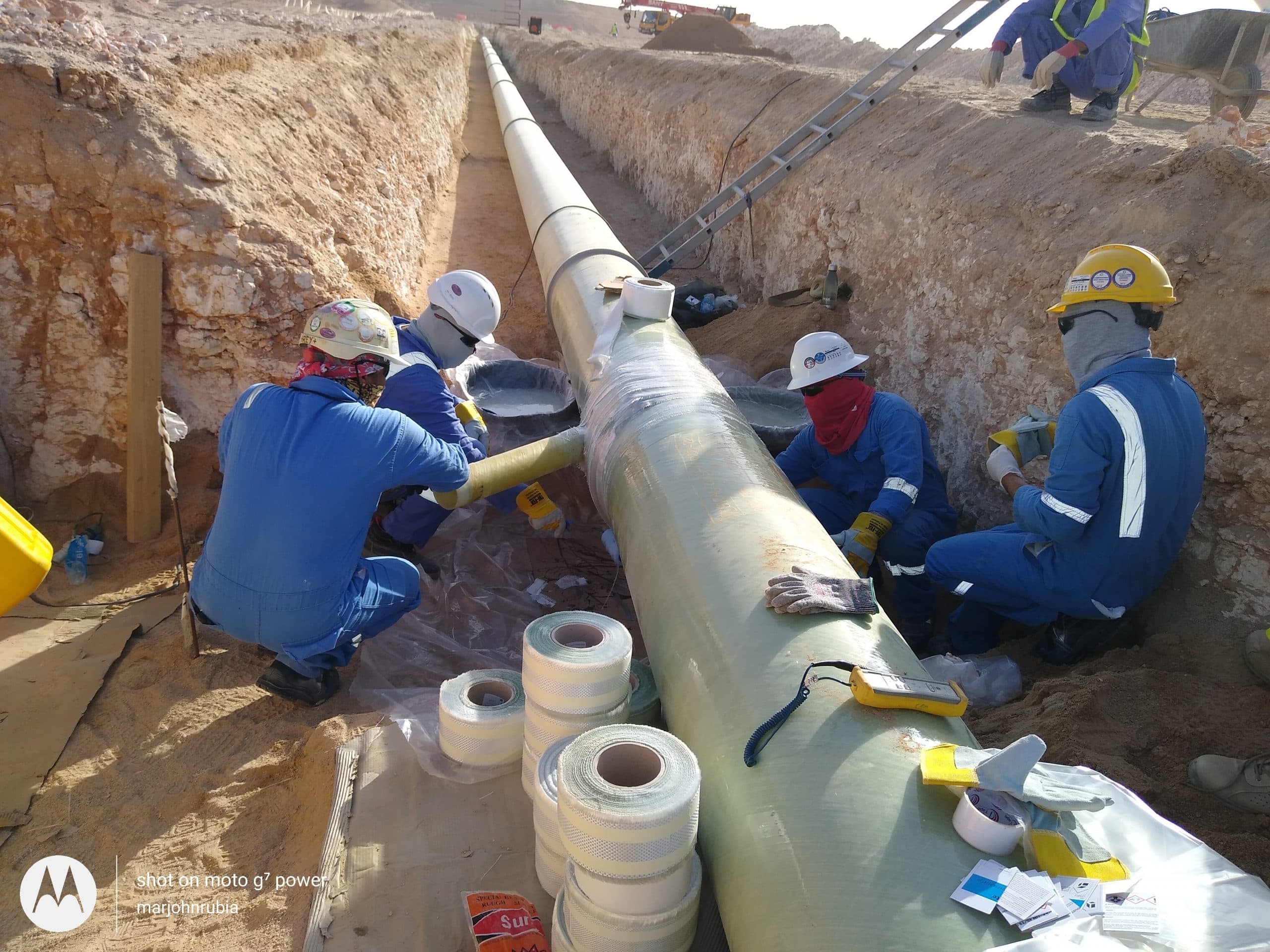
Polyester resins are commonly used to produce large-diameter water and sewage piping. Polyesters have excellent water and chemical resistance and are noted for acid resistance.
Polyester resins are cured by organic peroxide catalysts. The type and amount of catalyst will influence gel time, cure time, curing temperature, and the degree of cure.
Isophthalic Polyester
Isophthalic polyester resin is typically used. Isophthalic polyester is a relatively low cost resin, with limited chemical resistance.
Vinyl ester Resin
Compared to polyester, vinyl ester resin has very good chemical resistance, especially against acids.
High temperature and chemical resistant vinyl ester based resins, e.g. Novolac vinyl ester, are also available.
Premium Chemical Protection
Chemical resistance of GRP material
Resistance levels for different glass-fibre/resin combinations
| Fluid Type | GRE Aliphatic | GRE Aromatic | GRE Anhydride | GRV Vinyl ester | GRP Polyester |
|---|---|---|---|---|---|
| Acids | |||||
| Alkalis (Caustic) | |||||
| Solvents (BTX) | |||||
| Water Sea/Brackish |